If your business carries out work at construction sites, commercial premises or residential properties, you may have been asked by a builder, principal contractor or client to provide a Safe Work Method Statement (SWMS) before your workers are allowed onsite.
For many small and medium businesses, that request creates some confusion. What exactly is a SWMS? Is it just another safety document? Does every job require one? And can you simply use the same SWMS at every site?
Understanding the answers is important because, in certain circumstances, a SWMS isn’t simply something a client would like you to have – it is a legal requirement.
What is a SWMS?
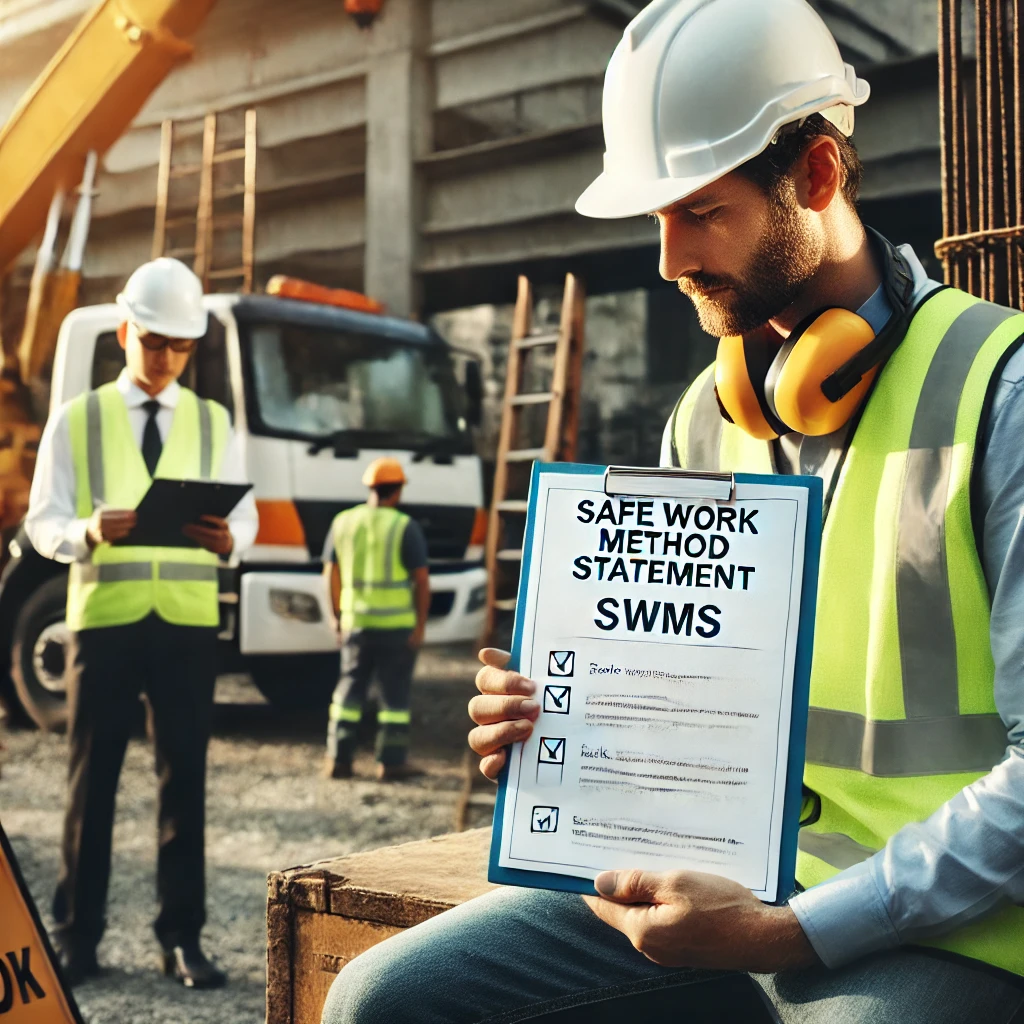
A Safe Work Method Statement is a document used to manage high-risk construction work.
A SWMS identifies the high-risk construction work being undertaken, the hazards and risks associated with that work, the measures being used to control those risks, and how those control measures will be implemented, monitored and reviewed.
This general approach applies across Australian jurisdictions, although the applicable legislation and specific requirements can differ between states and territories.
Victoria, for example, operates under its own Occupational Health and Safety legislation rather than the model Work Health and Safety laws. However, Victoria also has requirements for Safe Work Method Statements when high-risk construction work is being undertaken.
This is particularly important for businesses that operate across more than one state or territory. You should not simply assume that a document prepared for work in one jurisdiction will automatically address every requirement elsewhere.
Does every business need a SWMS?
No.
One of the common misconceptions is that every work activity requires a SWMS.
Generally, the statutory requirement for a SWMS arises where high-risk construction work is being undertaken.
Depending on the applicable legislation, examples of high-risk construction work can include:
- work involving a risk of a person falling from a prescribed height;
- work involving or potentially disturbing asbestos;
- certain demolition work;
- structural alterations requiring temporary support;
- work involving trenches or shafts beyond prescribed depths;
- work in confined spaces;
- certain work on or near energised electrical installations or services;
- work on or near certain gas, chemical, fuel or refrigerant lines;
- work in areas involving the movement of powered mobile plant;
- certain work near roads or railways involving traffic;
- work in or near water where there is a risk of drowning; and
- work involving activities such as explosives, diving, tunnels or certain contaminated or flammable atmospheres.
The exact definitions and requirements should always be checked against the legislation applying in the state or territory where the work is being undertaken.
What about working at a residential property?
The fact that your employees are working at someone’s home does not automatically remove your workplace health and safety obligations.
Consider businesses such as electricians, plumbers, landscapers, roofers, builders, air-conditioning installers, solar installers and other trades that regularly attend residential properties.
The important question isn’t simply whether the work is being performed at a house.
You need to consider what work is actually being undertaken and whether it meets the relevant definition of construction work and, importantly, high-risk construction work.
Likewise, attending a commercial property does not automatically mean a SWMS is legally required.
It is the work being undertaken and the risks associated with that work that need to be considered.
A business may also find that a principal contractor, builder or client has its own site requirements regarding safety documentation before contractors are permitted to commence work.
What should be included in a SWMS?
A SWMS needs to be more than a generic document sitting in the office or the glovebox of a work vehicle.
Depending on the applicable legislation, a SWMS will generally need to address matters such as:
- the high-risk construction work being undertaken;
- the hazards and risks arising from that work;
- the measures that will be used to eliminate or minimise those risks;
- how the control measures will be implemented;
- how the controls will be monitored; and
- how the controls will be reviewed.
The SWMS should also be relevant to the work actually being performed.
Businesses undertaking the same type of work regularly may be able to develop SWMSs covering recurring activities. However, that doesn’t mean the document should simply be copied from one job to another without consideration.
Before work starts, the business should consider whether the SWMS remains appropriate for the particular workplace, work environment and circumstances.
Your workers need to understand the SWMS
A SWMS isn’t supposed to exist simply to satisfy a builder, client, auditor or WHS inspector.
It needs to be used.
The workers undertaking the work need to understand the hazards, the control measures and what is expected of them.
The people actually undertaking the work can also provide valuable practical information when developing and reviewing a SWMS. They often understand the day-to-day hazards associated with a task better than someone preparing a document from an office.
There is little value in having a detailed SWMS that bears no resemblance to how the job is actually performed.
A SWMS is not the same as every other WHS document
Another area that causes confusion is the difference between a SWMS and other safety documents.
A SWMS is not necessarily the same as a risk assessment, Safe Operating Procedure (SOP), Job Safety Analysis (JSA), policy or general workplace procedure.
Your business may need several different types of WHS documentation depending on your operations.
The important thing is understanding what documentation is required, what purpose each document serves and how the documents work together as part of your overall WHS management system.
Is your SWMS actually protecting your business and workers?
If your business regularly sends employees or contractors to construction sites, commercial premises or residential properties, there are some important questions worth asking.
Do you know which of your activities require a SWMS?
Are your existing SWMSs current?
Do they reflect what your workers actually do?
Have the hazards and control measures been properly considered?
Are your workers familiar with the SWMSs relevant to their work?
Are they reviewed when the work, equipment, environment or risks change?
Would you be comfortable handing your SWMS to a principal contractor or WHS inspector?
Downloading a generic SWMS template from the internet may seem like a quick solution. However, a generic document may not properly reflect your business, equipment, workers, work methods or the hazards associated with the work you actually perform.
AHR can help with your SWMS requirements
Assurance HR Management can assist small and medium businesses to review their work activities and develop practical Safe Work Method Statements appropriate to their operations.
Rather than simply producing generic paperwork, we can work with you to understand the work your employees perform, identify the relevant hazards and risks, consider appropriate control measures and develop SWMS documentation that reflects how your business actually operates.
We can also review existing SWMSs to identify areas that may need updating or further development.
If you have been asked by a client or principal contractor for a SWMS, have workers attending residential or commercial sites, or simply aren’t sure whether your current SWMS documentation is adequate, talk to the AHR team on 1800 577515.
Assurance HR Management – The Workplace Problem Solvers!