1 July Has Come and Gone… Is Your Business Keeping Up?
New financial year. New workplace obligations. New risks for employers.
For many businesses, 1 July is associated with budgets, tax planning and end-of-financial-year reporting.
For employers, however, it is much more than the beginning of a new financial year. It is one of the most significant dates on the employment calendar, with annual changes to workplace legislation, wage rates, superannuation, employment thresholds and other employer obligations taking effect.
While most business owners are aware that “something changes on 1 July”, many are unsure exactly what has changed, how it affects their business, or whether their organisation has actually implemented those changes correctly.
The reality is that updating your payroll software is only one part of the process.
Every legislative change should prompt employers to review the systems, documents and workplace practices that support compliance across the organisation.
If that review hasn’t happened yet, now is the ideal time.
Compliance Doesn’t Happen Automatically
One of the biggest misconceptions we see is the belief that compliance simply happens because payroll software has been updated.
Unfortunately, employment law doesn’t work that way.
Changes to legislation often have a flow-on effect across multiple areas of a business, including:
- payroll administration
- employment agreements
- workplace policies
- employee handbooks
- manager responsibilities
- leave administration
- payroll procedures
- onboarding documentation
- human resource processes
Unless each of these areas has been considered, businesses can unintentionally leave themselves exposed.
Wage Increases Are About More Than Hourly Rates
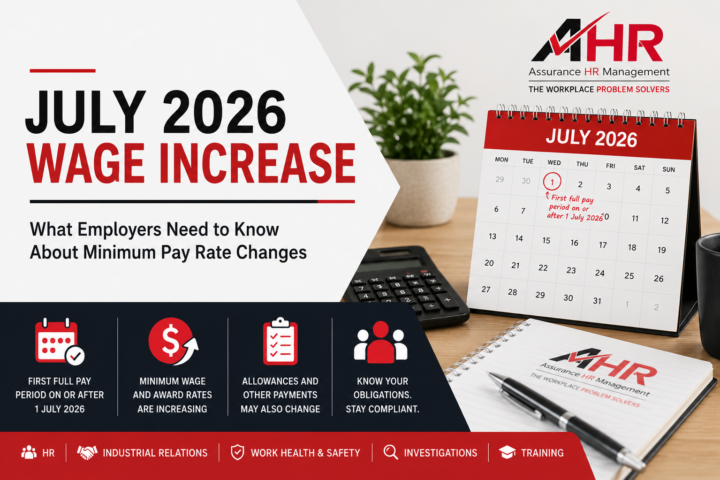
Each year, the Fair Work Commission reviews minimum wages and modern award rates.
Most employers understand they need to increase pay rates where required.
However, many overlook the other components that can also change.
These may include:
- allowances
- penalty rates
- overtime calculations
- weekend and public holiday payments
- apprentice and junior rates
- annual salary arrangements
- award classifications
Simply increasing an employee’s hourly rate does not necessarily mean the business remains compliant.
If an employee has been incorrectly classified, or an allowance has been overlooked, underpayments can still occur despite paying above the minimum hourly rate.
For businesses covered by Modern Awards, reviewing classifications should form part of every annual compliance review.
Superannuation Administration Is Becoming More Important Than Ever
Recent reforms continue to place greater emphasis on the timely payment of superannuation.
While many employers have historically managed superannuation through quarterly payment cycles, businesses should now ensure their payroll processes reflect current legislative requirements and that contributions are being processed correctly.
This isn’t simply an accounting exercise.
It affects:
- payroll workflows
- cash flow planning
- payroll approvals
- internal controls
- reporting processes
- reconciliation procedures
Businesses that leave payroll until the last minute each pay cycle may find these changes require a different approach to payroll management.
Employment Documents Should Never Sit in a Drawer
One of the most common issues we encounter is documentation that has not been reviewed for several years.
Employment agreements are signed.
Policies are issued.
Employee handbooks are distributed.
Then nothing changes.
Meanwhile, legislation continues to evolve.
Documents should be reviewed regularly to ensure they continue to reflect:
- current legislation
- Fair Work requirements
- workplace practices
- business operations
- contemporary case law
- organisational expectations
Outdated policies can create confusion, increase business risk and make it much harder to manage employee issues when they arise.
Managers Need to Understand the Changes Too
Compliance isn’t solely the responsibility of payroll or HR.
Your frontline managers make decisions every day that can create legal risk for your organisation.
They approve leave.
They manage performance.
They respond to complaints.
They authorise overtime.
They discuss flexible work arrangements.
They supervise injured workers returning to work.
If managers aren’t aware of current workplace obligations, the business can quickly find itself facing avoidable disputes.
Regular manager training remains one of the most effective risk management strategies available to employers.
Small Errors Can Become Expensive Problems
Employment law rarely creates problems overnight.
More often, businesses accumulate small administrative errors over months or years until a complaint is made.
Examples include:
- incorrect award classifications
- unpaid allowances
- outdated employment contracts
- inconsistent disciplinary procedures
- payroll calculation errors
- incorrect leave administration
- missing policy acknowledgements
- undocumented performance management
Individually, these issues may appear minor.
Combined, they can result in significant financial exposure.
By the time an employee lodges a complaint or a regulator commences an investigation, historical issues often need to be corrected retrospectively.
That can involve back payments, penalties, legal costs and considerable management time.
A New Financial Year Is the Perfect Time for a Workplace Health Check
Just as businesses review their financial position each year, they should also review the health of their employment practices.
A structured workplace compliance review allows organisations to identify issues before they become disputes.
Areas commonly reviewed include:
- employment agreements
- Modern Award coverage
- wage classifications
- payroll compliance
- workplace policies
- employee handbooks
- recruitment documentation
- probation processes
- performance management systems
- workplace investigation procedures
- workers’ compensation processes
- return-to-work systems
- workplace health and safety documentation
- psychosocial hazard management
Identifying a problem internally is always preferable to having it identified by a regulator—or by an employee’s lawyer.
Don’t Forget Workplace Health and Safety
Many employers focus heavily on Fair Work obligations while overlooking their WHS responsibilities.
A new financial year is an excellent opportunity to review:
- emergency procedures
- risk assessments
- Safe Work Method Statements
- contractor management
- consultation arrangements
- incident reporting
- first aid requirements
- training records
- psychosocial hazards
- workplace behaviour policies
Workplace Health and Safety legislation continues to evolve, particularly in relation to psychological health and organisational culture.
Employers who take a proactive approach are generally far better positioned should an incident occur.
The Cost of Doing Nothing
Some business owners delay reviewing their workplace systems because everything appears to be running smoothly.
Unfortunately, compliance isn’t measured by whether complaints have been made.
Many issues remain hidden until:
- an employee resigns
- a workers’ compensation claim is lodged
- a workplace investigation commences
- Fair Work makes enquiries
- an underpayment is identified
- an unfair dismissal application is filed
- a regulator requests documentation
By then, opportunities to prevent the problem have usually passed.
How Assurance HR Management Can Help
At Assurance HR Management (AHR), we work with businesses across Australia to take the complexity out of employment compliance.
Rather than expecting business owners to interpret changing legislation, update policies, review contracts and assess payroll obligations themselves, we do the work for you.
Our team can assist with:
- Workplace Compliance Reviews
- HR and Industrial Relations audits
- Employment Agreement reviews
- Award interpretation
- Payroll compliance reviews
- Workplace policy updates
- Employee handbook development
- WHS system reviews
- Psychosocial risk assessments
- Workplace investigations
- Workers’ compensation and return-to-work support
- Ongoing HR, IR and WHS advisory services
Whether you employ five people or five hundred, our goal is simple—to reduce your risk, improve compliance and allow you to focus on running your business with confidence.
Let Us Take Compliance Off Your To-Do List
Keeping up with employment legislation is becoming increasingly challenging.
Every year brings new obligations, revised requirements and changing expectations for employers.
Rather than wondering whether you’ve missed something, let our experienced team review your workplace systems and provide practical, commercially focused advice tailored to your business.
A proactive review today can prevent costly problems tomorrow.
Contact Assurance HR Management to arrange a Workplace Compliance Review and let us help ensure your business is ready—not just for today, but for whatever comes next.
Assurance HR Management – The Workplace Problem Solvers.